
Getting in Touch with Healing
By Shawn McAndrew,
Bay
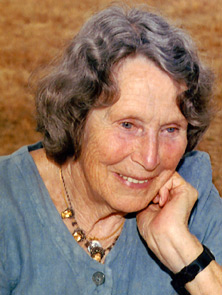
Area Business Woman Sunlight streams into the window of the Berkeley Hills
home where
Marion Rosen sits, her aura as brilliant as the sun1ight that frames
her face. But Berkeley is a long way from Rosen’s beginnings
in pre-war Germany where she studied bodywork from Lucy Heyer, one of
the innovators in the mind-body consciousness movement.
Rosen had an opportunity to study relaxation and
breath work with Heyer, who had been a student of Elsa Gindler, one of
the leaders in the German somatics movement. At the time, the German
government had declared that it was illegal for Jews to be taught, but
Heyer and her students rebelliously took in Rosen to study with them. This afternoon, Rosen is serene but a bit
apprehensive about answering questions regarding her methodology that
grew from her years of learning and practicing bodywork and physical
therapy. Rosen Method has been around for almost 30 years, and Rosen
quashes the idea immediately that she “created” it. “I didn’t create it. It
grew,” she says as she redirects the question to her cohort,
Sara Webb, a Rosen Method practitioner who was the impetus for Rosen to
teach her method to others.> “It came because this lady here (pointing
to Webb) wanted to know something I had learned in Germany, some kind
of massage,” Rosen continues. “She wondered if I
could teach her and I said, ‘No.” But Webb
prevailed and Rosen began to teach her and several other interested
students. Almost 30 years later, Rosen Method practitioners can be
found throughout the United States and in nine other countries. At 88 years of age, Rosen is both humble and
assured about Rosen Method. She has every right to be, as she has been
“growing” the method for over 60 years.
Rosen’s training with Heyer was in conjunction with work that
Heyer was conducting along with her husband, Gustav Heyer, a Jungian
psychoanalyst. The Heyers discovered that when people were treated with
psychotherapy and bodywork simultaneously, the psychotherapy produced
more immediate results. “People had an easier time getting in
touch with what they needed to get in touch with to get
well,” Rosen explains. Rosen experienced Heyer's bodywork treatment for
some migraines and realized that her headaches went away. "I said, `I'm
going to do this [work] for the rest of my life.' I knew there was
something in that touch." Rosen emigrated to the United States and ended up
in Berkeley, where she has remained since fleeing Nazi Germany. She
worked at Kaiser Medical Center in Richmond during World War II as a
physical therapist. Rosen says nobody knew about physical therapy in
the U.S. back then. "It only came up during the war when people got
hurt," she says. Webb adds that Rosen brought over a tradition of
natural healing from Germany. But Rosen sees it another way. "We don't
heal. We allow people to get well. We have created methods that are
very helpful to people." Rosen Method involves touch and asking questions
of
the client. "We are not the `knowing' people," Rosen declares. "We are
not the experts. We facilitate [the client's healing] by touching the
places where experiences and feelings are not allowed to be felt and
experienced."
Rosen explains that there have been scientific studies about physical touch and says that hormones, such as oxytosin, are emitted when people are touched in a gentle, healing way. The hormone creates peace and relaxation for the person receiving the touch. "For me, that is an explanation of why our touch (Rosen Method) has such an impact on people," Rosen continues. "We also talk, ask questions or tell them we feel their tightness. As we talk about it, they often start responding, `Yes, this happened to me.' Very often they've never talked about it before. People who confide, people who talk about their feelings apparently have a better working immune system."
There are some belief systems that maintain that our early childhood experiences shape how we present ourselves to the world. Rosen says that we store many of our emotions from these experiences in our muscles. "Rosen Method is totally connected to muscle memory," Rosen explains. "I think the muscles hold down the memory. When we cry, we don't cry with our toes or our knees. Where would the crying be? In our throats, sometimes in our diaphragm."
She points to her jugular muscles and says, "I call these the sadness muscles, not because they're sad, but because they hold back the sadness."
As a result of holding these emotions in, our bodies and ultimately our health, are shaped by unexpressed emotions. Rosen talks about a woman who came to see her who had had migraines every day for many years. The woman had had an abortion 30 years previously, and when Rosen started to work on her, the woman told Rosen about her emotional experience of having an abortion. As she spoke, the woman began to cry deeply and said that she had never spoken to anyone about the abortion. After her treatment, the woman's migraine went away and did not return.
Rosen emphasizes that it is important to talk about our experiences. "It is a remembering - remembering that we weren't always this way. There was one time when we had freedom and we can have freedom again.
"At times, [holding our emotions in] was a survival thing.Now it's not a survival thing. Now we're carrying something that is really not acute any more. This holding keeps us from doing other things. It keeps us from getting closer to other people. Then we feel it, so it is very painful and we cry. The pain from this is not very long. It's just a few minutes. Then comes the relief to have told it, to have remembered it again. It's out in the open now. Also to realize, `I survived it, here I am and I'm okay. I didn't think I would be okay at that time."'
In other words, Rosen Method gives us a safe place to be able to realize that an old memory is no longer valid. It allows us to come into the present.
Prodded by the idea that people spend thousands of dollars on books and workshops to achieve this awareness and healing, Rosen says people can spend a few hundred dollars on Rosen Method bodywork and achieve what they are wanting.
Rosen often comments in her introductory workshops on how different people look after they have experienced her bodywork method. "It has some kind of an influence on people and their surroundings," she explains.
But can we ever be as perfect as when we first enter this world?
"I don't know if we can get totally back to perfection because life isn't that way. But we can become aligned with what we were meant to be. Then we live a better life. It means we're just more alive."
And at 88, Rosen is still a physical therapist, a Rosen practitioner, and yes, she teaches Rosen Method bodywork. She is a living testament to what she teaches.
Look for Marion's new book, "Rosen Method Bodywork: Accessing the Unconscious through Touch" by Marion Rosen and Sue Brenner, Published by North Atlantic Books.
By Shawn McAndrew, Bay Area Business Woman, April 2003
Copyright 2003, On Your Marks, Inc.
Copyright remains with the author and original publisher of the work.
